Self-Driving Cars

Mukesh Kumar
| 04-12-2025
 · Vehicle Team
Imagine you're in a car, but you're not driving. Instead, you're sitting back while the car takes you to your destination, navigating streets, avoiding obstacles, and making decisions as if it were a human driver.
Sounds like science fiction? Actually, it's happening right now with autonomous vehicles.
The technology behind self-driving cars is complex, relying on multiple systems that work together to make decisions, from detecting objects to choosing the best course of action.
Understanding the architecture of autonomous vehicles is crucial to grasping how they "see" the world, make choices, and navigate safely. The journey from perception to decision is a multi-step process involving sensors, data processing, and machine learning.
Perception—How the Car Sees the World
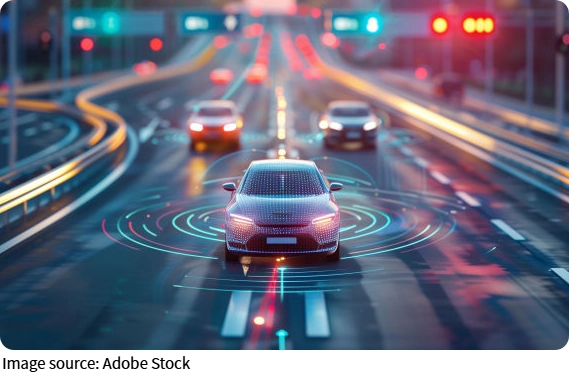
The first step in an autonomous vehicle's decision-making process is perception—essentially, how the car understands its surroundings. This is done through a combination of sensors like LIDAR, cameras, radar, and ultrasonic sensors. These systems gather raw data, helping the car build a comprehensive 3D map of the environment, detect other vehicles, pedestrians, and obstacles, and understand road conditions.
Key Perception Components:
LIDAR: Provides precise 3D mapping of the environment by emitting laser pulses and measuring the reflected light.
Cameras: Offer visual recognition of road signs, traffic lights, and pedestrians.
Radar: Detects objects and measures their speed and distance, useful in adverse weather conditions.
Ultrasonic Sensors: Used for short-range detection, like parking sensors.
By combining data from all these sources, the vehicle has a detailed, real-time picture of what's around it.
Data Processing—Turning Raw Data Into Actionable Information
Once the sensors collect the data, the next challenge is processing it. Autonomous vehicles use powerful onboard computers and algorithms to make sense of this information. Data from LIDAR, cameras, and other sensors are fused together into a cohesive model of the environment. Machine learning plays a critical role in improving the vehicle's understanding of various situations and predicting potential hazards.
Data Processing in Action:
Object Recognition: The car must recognize the objects in its environment—pedestrians, vehicles, traffic signs—by analyzing sensor data and comparing it to vast databases of images and patterns.
Environmental Mapping: The car needs to understand the layout of the road, including lane markings, intersections, and traffic signs, to navigate safely.
Predictive Algorithms: Using machine learning, the vehicle predicts the movement of pedestrians, cyclists, or other cars, which helps it decide when to stop, slow down, or change lanes.
The goal is to make the vehicle "aware" of everything around it so that it can react appropriately to any situation, just like a human driver would.
Decision-Making—Choosing the Best Action
After gathering data and processing it, the self-driving car must decide what to do with that information. This is the "thinking" part of the autonomous driving system. The vehicle's onboard decision-making system uses the processed data to choose the best course of action based on a variety of factors.
How Decision-Making Works:
Navigation Decisions: The system chooses the optimal route, taking into account traffic, road conditions, and destination.
Safety Considerations: The car must decide when to slow down, stop, or avoid an obstacle to ensure safety. For example, if a pedestrian steps into the street, the car must decide how to react in real-time.
Real-Time Adjustments: The system continuously re-evaluates its decisions based on new inputs. For instance, if another vehicle cuts in front, the car may decide to change lanes or adjust speed to avoid a collision.
This decision-making process is powered by deep neural networks and reinforcement learning algorithms that allow the vehicle to adapt and improve over time. The more the car "drives" (or tests scenarios), the better it becomes at predicting and responding to various driving situations.
Control—Executing the Decision
Once a decision has been made, the car needs to act on it. This is where the control systems come in. The control system translates the decisions into physical actions like steering, accelerating, or braking. It takes real-time data from sensors and continuously adjusts the vehicle's behavior to ensure it stays on course.
Control Systems in Action:
Steering: The car uses its control system to steer based on its navigation decisions, keeping the car in its lane or turning when necessary.
Acceleration/Braking: The system adjusts the car's speed based on the situation—accelerating when it's clear to go or braking to avoid a collision.
Coordination: Everything happens simultaneously in real-time. The control system works with the sensors to ensure the car follows its route and responds to changes without delay.
Challenges and Future of Autonomous Vehicle Technology
While the architecture behind autonomous vehicles is impressive, it's not without its challenges. One of the biggest hurdles is ensuring that the vehicle can handle every possible scenario, especially in unpredictable environments. Weather, complex traffic situations, and rare or extreme events can still pose challenges.
However, as AI and machine learning continue to evolve, these systems will only improve. Self-driving cars are becoming more capable of navigating complicated urban environments, handling edge cases, and making safe, reliable decisions.
The future of autonomous vehicles holds great promise. As more data is collected and systems become more sophisticated, we can expect cars that not only mimic human driving but also surpass human judgment in safety, efficiency, and decision-making speed.
By understanding the full technology stack behind autonomous driving—from perception to decision-making to execution—we can better appreciate how close we are to making self-driving cars a common reality on our roads.