How Self-Driving Cars See

Ravish Kumar
| 03-12-2025
 · Vehicle Team
When you think about driving, your mind might conjure images of the road, other cars, pedestrians, and traffic signs—everything you'd need to avoid accidents or make smooth turns.
But for a self-driving car, this task becomes far more complex. Instead of relying on a human driver's eyes and instincts, autonomous vehicles use a combination of sensors and cameras to understand their environment.
Two of the most important technologies enabling this "vision" are LIDAR (Light Detection and Ranging) and cameras. These tools are crucial in helping self-driving cars interpret the world around them and make the decisions necessary to drive safely.
What Is LIDAR and How Does It Work?
LIDAR is one of the most essential components in a self-driving car's sensor suite. Think of it as the car's “eyes” in 3D, using lasers to map out the environment in real-time. LIDAR sends out rapid pulses of light (laser beams) and measures the time it takes for each pulse to reflect back to the sensor. By analyzing these time measurements, the car can create a detailed 3D map of its surroundings, identifying obstacles, road conditions, and even the shape of other vehicles.
Advantages of LIDAR:
1. Precision: LIDAR can create highly accurate, detailed maps of the environment, even detecting small objects like debris on the road or slight changes in terrain.
2. Night Vision: Unlike cameras, LIDAR doesn't depend on light to work, making it effective for nighttime driving or low-light conditions.
3. All-Weather Capability: LIDAR is less affected by adverse weather conditions like fog or rain, which can impair camera-based systems.
However, LIDAR isn't perfect. Its main limitation is its range and cost. While it's excellent at identifying nearby objects, it struggles with objects far away, and LIDAR sensors can be expensive to install on vehicles.
The Power of Cameras in Autonomous Driving
While LIDAR provides an accurate, 3D representation of the environment, cameras give self-driving cars the ability to recognize colors, shapes, and textures. Cameras are essential for detecting traffic lights, street signs, road markings, and other visual cues that are necessary for safe driving.
Benefits of Cameras:
1. Object Recognition: Cameras allow the vehicle to "see" objects in the environment, recognizing pedestrians, cyclists, and other vehicles. They work similarly to human vision, interpreting visual patterns and objects based on light.
2. Traffic Signals and Signs: Cameras are ideal for recognizing traffic signals, stop signs, and other important indicators, helping the car obey traffic laws and navigate intersections.
3. Cost-Effectiveness: Cameras are much cheaper than LIDAR and easier to install, making them an attractive option for many autonomous vehicle developers.
However, cameras also come with significant limitations. Their performance can be severely affected by poor weather conditions, like heavy rain or fog, and they can struggle with low-light situations, such as night driving. Additionally, their ability to create a full 3D map of the environment is limited compared to LIDAR.
The Synergy Between LIDAR and Cameras
While both LIDAR and cameras are powerful on their own, together, they provide a much richer and more accurate understanding of the environment. The combination of these technologies allows self-driving cars to overcome the limitations of each individual system.
How They Work Together:
1. Complementary Strengths: LIDAR gives precise distance measurements and depth perception, which is essential for detecting obstacles in 3D space. Cameras, on the other hand, help the car understand the color and texture of objects, like identifying a pedestrian's clothing or a red stoplight.
2. Redundancy for Safety: The integration of both systems allows for redundancy—if one system fails, the other can step in to prevent errors or accidents. For instance, while a camera might struggle in foggy conditions, the LIDAR system can still detect obstacles, ensuring the vehicle stays on track.
3. Enhanced Decision-Making: With both LIDAR and cameras working together, the vehicle can make better decisions in real-time. For example, if the camera detects a stop sign, LIDAR can confirm the sign's position, ensuring the car knows exactly where it is on the road.
Real-World Applications: How Autonomous Vehicles Use These Tools
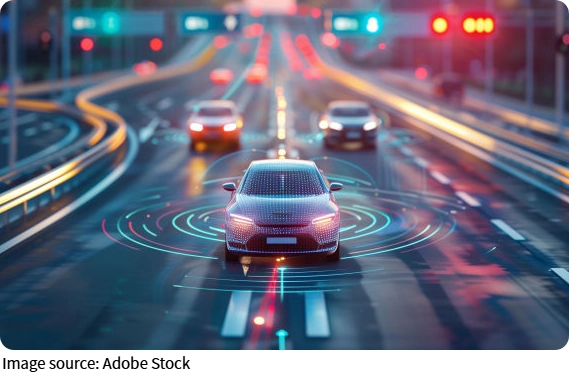
In practical terms, self-driving cars rely on a suite of sensors and cameras to navigate the world. When you're in the car, you might not notice, but these systems are constantly working to make driving safer. For example, if a self-driving car is approaching an intersection, it will use its cameras to identify the traffic light, LIDAR to map the intersection and surrounding objects, and radar to detect any vehicles or pedestrians nearby.
This combination of tools allows the car to make decisions about when to slow down, stop, or turn.
Example Scenario:
Imagine the car approaches an intersection at night, where a pedestrian is crossing the street. The LIDAR will create a 3D map of the intersection, detecting the pedestrians even if the cameras have difficulty seeing them in low-light conditions. The car then slows down and stops, thanks to the combined input from both systems, ensuring that it never misses an obstacle or makes a dangerous decision.
Looking Ahead: Advancements in Perception Technology
As self-driving technology continues to evolve, the role of sensors like LIDAR and cameras will become even more critical. Researchers are working to improve the capabilities of both systems, making them more affordable, efficient, and effective in all conditions. Advances in AI and machine learning will also allow the car to better understand complex situations and make decisions that are more like those a human driver would make.
In the near future, we can expect to see more advanced versions of both LIDAR and camera systems, with even better integration and redundancy. These improvements will help make autonomous vehicles safer, more reliable, and closer to becoming a standard mode of transportation for everyone.
With the right blend of technologies, self-driving cars will one day be able to navigate our streets as effectively as human drivers, if not more so, creating a safer and more efficient driving experience for all.